

D2.6 - Third report of the Ethics Advisory Board (EAB)
After the last two previous meetings of our Ethics Advisory Board (EAB) -which resulted in reports D2.2 and D2.4-, the EAB members were presented with the updated position with regards to the project objectives and progress, the data protection and ethics oversight and assessments for the project. In this period, GenoMed4All focused its efforts on the finalisation of the Joint Controller Agreements (JCAs), enhancement of the Federated Learning architecture and development of the recommendations on the ethical principles, quality processes and stakeholder engagements for AI development as can be found in deliverable D2.5.
Abstract
Deliverable 2.6 provides the third report of the Ethical Advisory Board for GenoMed4All. The 3rd Meeting took place on Monday 20th November 2023 and provided an opportunity for the project to update the EAB external members on the latest developments over 2023. The key points of development included the completion and signing and execution of three Joint Controller Agreements for each of the Use Cases, further technical developments that place the majority of personal data processing on a Federated Learning infrastructure and finalisation of the approach to develop the Ethical Principles and Quality Assurances for Deliverable 2.5. There was also reflection on the recently enacted Data Governance Act and the forthcoming AI Act and regulations around the European Health Data Space.
Photo by Clark Van Der Beken on Unsplash


Opportunities and Challenges of Synthetic Data Generation in Oncology
Abstract
Widespread interest in artificial intelligence (AI) in health care has focused mainly on deductive systems that analyze available real-world data to discover patterns not otherwise visible. Generative adversarial network, a new type of inductive AI, has recently evolved to generate high-fidelity virtual synthetic data (SD) trained on relatively limited real-world information. The AI system is fed with a collection of real data, and it learns to generate new augmented data while maintaining the general characteristics of the original data set. The use of SD to enhance clinical research and protect patient privacy has drawn a lot of interest in medicine and in the complex field of oncology. This article summarizes the main characteristics of this innovative technology and critically discusses how it can be used to accelerate data access for secondary purposes, providing an overview of the opportunities and challenges of SD generation for clinical cancer research and health care.
The need for multimodal health data modeling: A practical approach for a federated-learning healthcare platform
Abstract
Federated learning initiatives in healthcare are being developed to collaboratively train predictive models without the need to centralize sensitive personal data. GenoMed4All is one such project, with the goal of connecting European clinical and –omics data repositories on rare diseases through a federated learning platform. Currently, the consortium faces the challenge of a lack of well-established international datasets and interoperability standards for federated learning applications on rare diseases. This paper presents our practical approach to select and implement a Common Data Model (CDM) suitable for the federated training of predictive models applied to the medical domain, during the initial design phase of our federated learning platform. We describe our selection process, composed of identifying the consortium’s needs, reviewing our functional and technical architecture specifications, and extracting a list of business requirements. We review the state of the art and evaluate three widely-used approaches (FHIR, OMOP and Phenopackets) based on a checklist of requirements and specifications. We discuss the pros and cons of each approach considering the use cases specific to our consortium as well as the generic issues of implementing a European federated learning healthcare platform. A list of lessons learned from the experience in our consortium is discussed, from the importance of establishing the proper communication channels for all stakeholders to technical aspects related to –omics data. For federated learning projects focused on secondary use of health data for predictive modeling, encompassing multiple data modalities, a phase of data model convergence is sorely needed to gather different data representations developed in the context of medical research, interoperability of clinical care software, imaging, and –omics analysis into a coherent, unified data model. Our work identifies this need and presents our experience and a list of actionable lessons learned for future work in this direction.

D8.2 - Training programme definition
This deliverable sets the stage for what will become GenoMed4All’s training programme for Artificial Intelligence and precision medicine in Hematology: from the nomination of our Educational Committee to the design and careful planning of the two waves of training webinars (Wave #1 for the public at large and Wave #2 for an expert audience).
Abstract
This deliverable comprises the first phase of the design of the GenoMed4All training programme, which is focused on the definition of the topics, methodologies and training materials. D8.2 is the result of the collaborative work performed by GenoMed4All Educational Scientific/Technical Committee towards the definition of the GenoMed4All training programme.
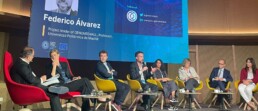
GenoMed4All at Expo Dubai 2020
A few weeks ago we were invited by the European Commission and InTouchAI.eu –the International Outreach Office on human-centric AI– to participate in the EU AI Week (14-18 March 2022) at Expo Dubai, as a way to showcase European Excellence and Trust in Artificial Intelligence around the world.
In the frame of this high-level event, InTouchAI.eu hosted a series of sessions on the European approach to AI. One of these events was the Expert Workshop on AI for Health, in which our coordinator, Federico Álvarez, participated as a panelist. He was also accompanied by representatives from 2 other EU-funded projects: DIH-HERO and EuCanImage.
The panel focused on practical examples of European AI excellence in the healthcare sector and discussed the practical implications of AI in healthcare, mostly on how to reconcile social and ethical aspects in a human-centric approach to AI that upholds our European values. After the official round of introductions and a brief overview of the guest projects, the panelists engaged in open discussion. Federico's interventions focused on the concept of federation and how we understand it in GenoMed4All. We are dealing with very sensitive data (namely genomics, imaging and clinical data), while also operating in the realm of rare diseases, which inevitably adds another layer of complexity to the search for new AI models and patterns in hematological disorders.
[on]... the concept of federation, we go a bit beyond, we do Federated Learning. [...] Would any of you like to share your genomic information openly? Maybe not. But if we do it in a way that this information stays in the hospital where the patient gave their consent, then we can create a big network and this [...] for hematological diseases is really important, because they are rare: there are not so many cases in Europe, so we want to connect all the repositories.
Apart from data scarcity and fragmentation, another great challenge to be mindful of is the issue of data sharing and cross-border exchanges of health data. While cautious, Federico remained hopeful on this front:
[...] We are working on ethics and legal protection, and what I find interesting is that if we want to cooperate outside Europe, we already know how to, we can export that to the rest of the world, and they can join this federated infrastructure. It's not an issue! Engineers will find a way of coping with models that can exchange cross-border data in a way that can preserve privacy, data protection and our European values. Another point we think is relevant is the standardization of genomic information, so we also want to find a way for people to cooperate with the same standards on their research.
When asked about the long-term sustainability of the project, Federico presented our vision for GenoMed4All's platform and how this privacy-by-design approach will be fundamental to scale up and onboard more and more clinical sites through distributed algorithms. The challenge, as always, lies in how to effectively transform research breakthroughs into solutions with clear clinical usability and fully compliant with current regulations so that AI can have a real, positive impact in the lives of so many European patients.
[The key is in] ...really connecting all these different hospitals, clinics... places where we can find this data, especially for some diseases that are not so common, and [...] on how to transition from researchers doing something that is valuable to bringing something to the hospitals that will work and be adopted, so that finally European patients can benefit from AI.
All in all, this event was the perfect opportunity to present our views on AI and its potential to drive the future of personalized medicine in hematological diseases and it was an honour to share the stage with some fantastic experts. Check out the workshop livestream below for the full experience!

D2.2 - First Report of the Ethics Advisory Board
Following the introductory meeting of our Ethics Advisory Board (EAB) -you can read all about it here-, their first report (D2.2) has been publicly released.
Abstract
This deliverable provides the first report of the GenoMed4All Ethical Advisory Board (EAB). The report has been compiled after the first meeting of the Ethical Advisory Board held on 19th January 2022. The meeting was presented with the current position with regards the project objectives and progress, data protection and ethics oversight and assessments for the project.
Photo by Fábio Lucas on Unsplash

D4.1 - Hybrid Federated Learning Model
D4.1 is finally out!
This deliverable is the result of months of intense discussions on GenoMed4All’s hybrid Federated Learning framework.
Abstract
The main aim of this deliverable is to define GenoMed4All’s hybrid federated learning model specification expressed in terms of platform requirements, which have been acquired by analyzing in details the project’s objectives as well as by decomposing the stakeholders’ needs through the different use cases’ definition. It includes a description of the requirements elicitation methodology together with the set of technical requirements regarding the federated learning approach of the project’s platform. Moreover, it includes an extensive analysis of the most important federated learning framework solutions already available, and it finally defines the evaluation criteria that have helped in the selection of the most appropriate one for the project’s purposes and needs.
Photo by Denis Sebastian Tamas on Unsplash