
Benefits of Radiomics in hematology: improved Identification of Cerebral Silent Infarct across the lifespan in a real-world Sickle Cell Disease European Cohort
Abstract
Poster presented by Maria Paola Boaro (Università di Padova) at the AI4H Padova – Artificial Intelligence for Healthcare congress, under the title: “Benefits of Radiomics in hematology: improved Identification of Cerebral Silent Infarct across the lifespan in a real-world Sickle Cell Disease European Cohort”


GenoMed4ALL: Improving SCD Classification and Prognosis by AI
Study overview
GenoMed4All ‘Genomics and Personalized Medicine for all though Artificial Intelligence in Haematological Diseases’ aims to advance on individual SCD patients’ disease characterisation and to improve the monitoring of patients’ health status, optimise clinical therapy guidance and ultimately improved health outcomes by the identification of biomarkers and the development of individual (risk) models in SCD. Genomed4All supports the pooling of genomic, clinical data and other “-omics” health through a secure and privacy respectful data sharing platform based on the novel Federated Learning scheme, to advance research in personalised medicine in haematological diseases thanks to advanced Artificial Intelligence (AI) models and standardised interoperable sharing of cross-border data, without needing to directly share any sensitive clinical patients’ data. The SCD Use case will gather multi-modal clinical and -OMICs data from 1,000 SCD patients in 4 EU-MS: France, Italy, Spain and The Netherlands.

Sickle cell disease landscape and challenges in the EU: the ERN-EuroBloodNet perspective
Abstract
Sickle cell disease is a hereditary multiorgan disease that is considered rare in the EU. In 2017, the Rare Diseases Plan was implemented within the EU and 24 European Reference Networks (ERNs) were created, including the ERN on Rare Haematological Diseases (ERN-EuroBloodNet), dedicated to rare haematological diseases. This EU initiative has made it possible to accentuate existing collaborations and create new ones. The project also made it possible to list all the needs of people with rare haematological diseases not yet covered health-care providers in the EU to allow optimised care of individuals with rare pathologies, including sickle cell disease. This Viewpoint is the result of joint work within 12 EU member states (ie, Belgium, Cyprus, Denmark, France, Germany, Greece, Ireland, Italy, Portugal, Spain, Sweden, and The Netherlands), all members of the ERN-EuroBloodNet. We describe the role of the ERN-EuroBloodNet to improve the overall approach to and the management of individuals with sickle cell disease in the EU through specific on the pooling of expertise, knowledge, and best practices; the development of training and education programmes; the strategy for systematic gathering and standardisation of clinical data; and its reuse in clinical research. Epidemiology and research strategies from ongoing implementation of the Rare Anaemia Disorders European Epidemiological Platform is depicted.
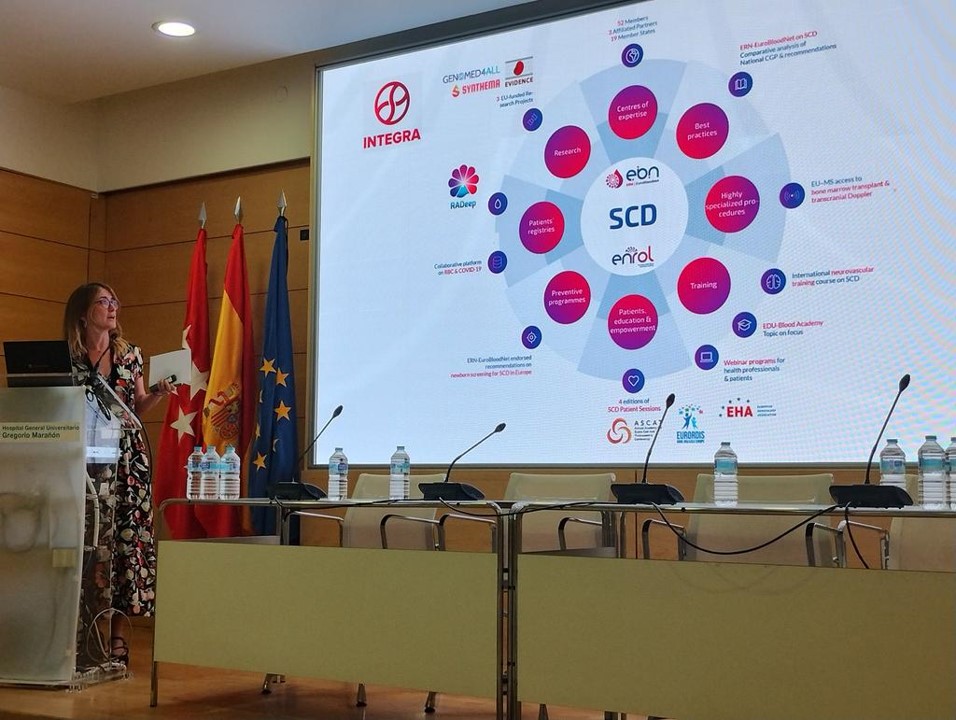
GenoMed4All highlighted as one of Europe’s top research programs during World Sickle Cell Day 2023
To commemorate this year’s World Sickle Cell Day, on 19th June, ERN-EuroBloodNet have put the spotlight on the European research and education initiatives fighting to improve the lives of individuals and families affected by this condition. We are very proud to see GenoMed4All listed alongside other EU-funded initiatives — including EVIDENCE, INHERENT, EDITSCD and our sister project SYNTHEMA — in this interactive poster created by ERN-EuroBloodNet to mark the occasion.
Mar Mañú Pereira, Principal Investigator at our partner institution Vall d’Hebron Institute of Research (VHIR), also introduced the work carried out by GenoMed4All’s consortium and the other four projects during a presentation to the Sickle Cell Disease Spanish Association (ASAFE) earlier this week, coinciding with ERN-EuroBloodNet’s campaign in celebration of World Sickle Cell Day 2023.
According to the Global Alliance of Sickle Cell Disease Organizations (GASCDO), one of this year’s themes is dedicated to raising awareness about the latest technological advancements in the SCD field, helping patients and healthcare professionals to identify the current status of the disease. The partners involved in GenoMed4All believe that technology, especially Artificial Intelligence, holds the power to bring new and improved diagnosis and prognosis into the future of healthcare, which in turn will positively contribute to the future of those suffering from rare haematological diseases, such as Sickle Cell.


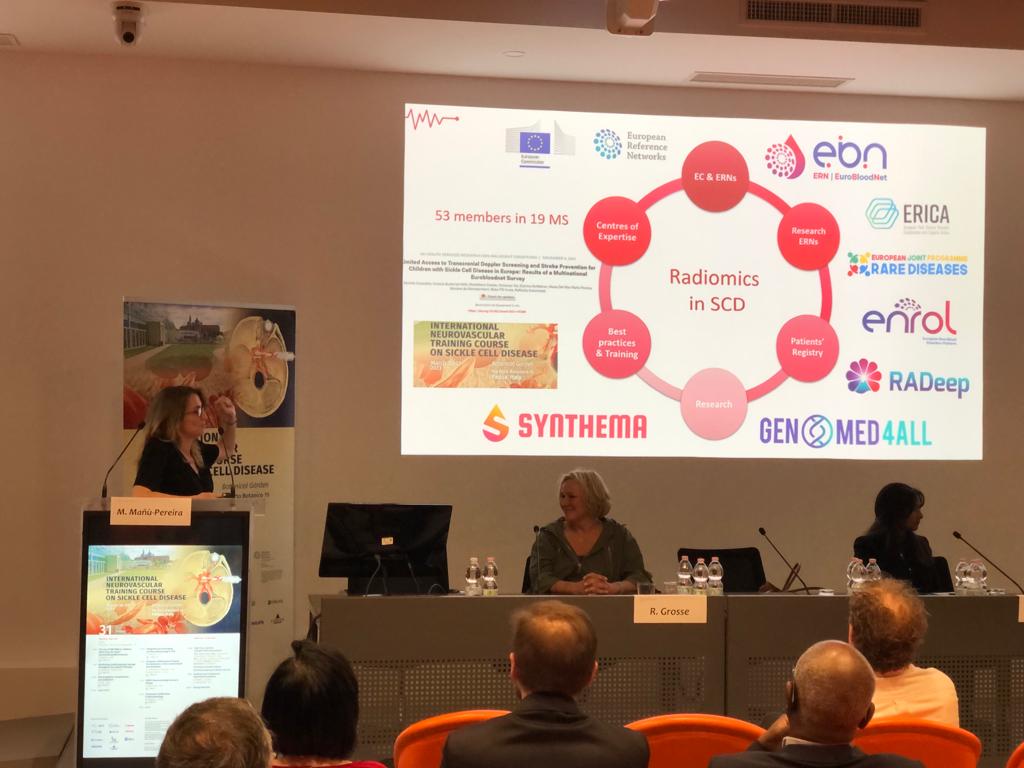
Radiomics in SCD - GenoMed4All at the International Neurovascular Training Course on SCD
GenoMed4All has been featured along with sister project SYNTHEMA at the International Neurovascular Training Course on Sickle Cell Disease -held in Padua last week- as one example of ERN-EuroBloodNet's European Collaborative Projects for radiomics in SCD. Many thanks to our colleagues Mar Mañú (VHIR) and Raffaella Colombati (UNIPD) for a job well done!
Challenges and Opportunities of Precision Medicine in Sickle Cell Disease: Novel European Approach by GenoMed4All Consortium and ERN-EuroBloodNet
Abstract
SCD research in Europe is limited by the relatively small, variable, and widely dispersed patient cohorts. In addition, the lack of harmonization among the repositories hampers world-wide collaborations. Artificial Intelligence (AI) can aid in analyzing large quantities of data, but only if it is collected and organized in a standardized way. To overcome some of the presented issues, GenoMed4All6 is a European initiative to provide personalized solutions for hematological diseases’ control and prevention by exploiting the power of AI.
Integrative diagnosis of Sickle Cell Disease patients for Personalized Medicine
Abstract
Sickle cell disease (SCD) is a chronic life threatening disorder, caused by the presence of structurally abnormal adult hemoglobin S (HbS). Under low oxygen saturation, HbS forms hemoglobin polymers that deform the red blood cell structure, referred to as ‘sickling’. Sickled erythrocytes result in hemolytic anemia and recurrent vaso-occlusive crisis, which lead to long-term morbidity and early death. The patient specific pO2 at which sickling starts (PoS) along with RBC deformability at normoxia (EImax) and upon deoxygenation (EImin) can be measured by oxygen gradient ektacytometry (Laser Optical Rotational Red Cell Analyzer (LoRRca)). In the GenoMed4ALL project, oxygen gradient ektacytometry data will be integrated with genomics, metabolomics and clinical data of 1000 SCD patients, allowing better characterization of SCD and development of Artificial Intelligence (AI) algorithms for personalized medicine.
Radiomics and Artificial Intelligence for identification and monitoring of silent cerebral infarcts in Sickle Cell Disease: First analysis from the GenoMed4All European Project
Abstract
The use of Artificial Intelligence (AI) for personalized medicine has recently guided improvements in the diagnostic pathway of many diseases. The EU Project GENOMED4ALL: “Genomics and personalized Medicine for All through Artificial Intelligence in Haematological Diseases” aims at using European data of patients affected by Sickle Cell Disease (SCD) to find correlation between -omics data – and phenotype, seizing the opportunity to improve diagnostics through AI.
2,3-diphosphoglycerate detection via direct infusion high-resolution mass spectrometry correlates with quantitative detection in blood patients with SCD
Abstract
Sickle cell disease (SCD) is a hereditary and chronic life-threatening disorder, characterized by haemolytic anaemia. Increased 2,3-diphosphoglycerate (2,3-DPG) concentrations, along with decreased oxygen affinity of hemoglobin, may be related to the variability of clinical outcomes in SCD. Furthermore, genomic health data holds promise to improve the prediction of disease severity in SCD. Based on the integration of genomics, metabolomics and clinical data from 1000 SCD patients, to be included in 2022, GenoMED4all aims to develop Artificial Intelligence (AI) based deep learning algorithms to improve the prediction of disease severity and phenotype in SCD.
GenoMed4All at the IUBMB Focused Meeting - Hemoglobin Switching Conference
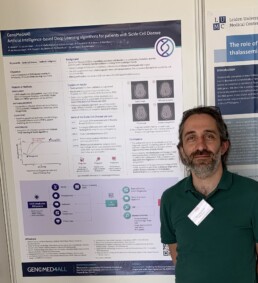
This month has been a busy one! Early in May, GenoMed4All participated in the IUBMB Focused Meeting - Hemoglobin Switching Conference, a reference event for scientific exchange and dialogue on globin gene regulation and pathophysiology.
The Sickle Cell Disease (SCD) team proudly presented a poster showcasing the work done so far, titled: "GenoMed4All: Artificial Intelligence-based Deep Learning algorithms for patients with Sickle Cell Disease". Our colleague Petros Kountouris -from The Cyprus Institute of Neurology & Genetics- was there on behalf of the project and reports that there was a lot of interest from the participants in these specific results.
Congratulations to everyone involved! You can check out the poster here at our Zenodo repository.