

Humanitas Research Hospital attend ASH 2024 in representation of GenoMed4All
For another consecutive year, GenoMed4All was present at the ASH meeting in San Diego, thanks to the participation of investigators from Humanitas Research Hospital.
The 66th American Society of Hematology (ASH) Annual Meeting and Exposition, held in California on 7-10 December 2024, showcased the latest research and developments in hematology, serving as a pivotal gathering for hematology professionals from across the globe.
Also in representation of our sister project SYNTEHMA, our shared consortium partner Humanitas Research Hospital presented 6 abstracts that highlighted the transformative potential of artificial intelligence in advancing personalized and precision medicine for hematological diseases.
Through five poster presentations and one conference talk, the Humanitas team, led by Matteo Della Porta, unveiled the work they’ve been developed in the last year:
- ‘Artificial Intelligence-Powered Digital Pathology to Improve Diagnosis and Personalized Prognostic Assessment in Patients with Myeloid Neoplasms’ by Gianluca Asti
- ‘An Artificial Intelligence-Based Federated Learning Platform to Boost Precision Medicine in Rare Hematological Diseases: An Initiative by GenoMed4All and SYNTHEMA Consortia’ by Gianluca Asti
- ‘A Comprehensive, Artificial Intelligence-Based, Digital Twin Platform Based on Multimodal Real-World Data Integration for Personalized Medicine in Hematology’ by Saverio D’Amico
- ‘Generation of Multimodal Longitudinal Synthetic Data by Artificial Intelligence to Improve Personalized Medicine in Hematology’ by Saverio D’Amico
- ‘Enhancing Personalized Prognostic Assessment of Myelodysplastic Syndromes through a Multimodal and Explainable Deep Data Fusion Approach’ by Elisabetta Sauta
The active participation of GenoMed4All and SYNTHEMA at ASH 2024 underscored their commitment to integrating AI into hematology to improve patient outcomes. Engaging with the global hematology community at such a high-profile event facilitated the dissemination of their innovative research findings, fostering discussions on the practical applications of AI in clinical settings.

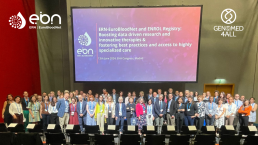
GenoMed4All at EHA 2024: Reinforcing our commitment to advance innovation in hematology
The European Hematology Association (EHA) Annual Congress is one of the most significant events in the field of hematology, bringing together experts, researchers and industry leaders from around the world.
The 3rd edition of the conference took place in Madrid, on 13-16 June 2024, to provide a closer look at the latest advancements in hematology, particularly around research, treatments and policy. This year’s theme focused on fostering innovation and collaboration to improve patient outcomes, emphasizing the role of cutting-edge technologies in shaping the future of hematology.
As part of this prestigious event, partners of GenoMed4All and sister project SYNTHEMA participated in a dedicated session organized by ERN-EuroBloodNet, titled ‘Data driven research & Innovative therapies’. María del Mar Mañú Pereira, Head of Rare Anemia Disorders Laboratory at Vall d’Hebron Institute of Research (VHIR), and Raffaella Colombatti, Pediatric Hematologist and Associate Professor at University of Padova, presented the core objectives of both EU-funded initiatives, with a particular focus on the work carried out for the Sickle Cell Disease case study.
Other GenoMed4All representatives also attended EHA 2024 in Madrid to help disseminate the project’s mission and engage with the broader hematology community, including: Federico Álvarez from Universidad Politecnica de Madrid, Matteo Della Porta from Humanitas Research Hospital, and Diana López from AUSTRALO.
Being present at such a high-profile event is crucial for increasing awareness about our work, and contributing to discussions on the latest scientific and technological developments in the field. Beyond the scientific discourse, EHA 2024 reaffirmed the importance of collective efforts in driving innovation and improving patient care, reinforcing GenoMed4All’s commitment to advancing hematological research through technology-driven solutions.


A brief introduction to our sister project SYNTHEMA
SYNTHEMA is a Horizon Europe research and innovation action that aims to establish a cross-border health data hub for rare haematological diseases (RHDs).
Haematological diseases are highly diversified, with oncological and non-oncological subcategories. The scarcity and fragmentation of patient data across scattered transnational repositories hinder effective health planning and make difficult to engage in basic and clinical research. SYNTHEMA aims to tackle this challenge by establishing a research platform connecting clinical centres of excellence in the research and care of RHDs, technical research centres, industries and SMEs, to advance translational and clinical research by generating and validating anonymised and synthetic data in RHDs.
To ensure data security and patients’ privacy, the project will make use of a federated learning (FL) infrastructure, privacy preserving by design, that will allow to iteratively train, refine and validate AI algorithms at hospital premises, without sharing of data outside local repositories. Also, it will equip it with secure multi-party computation (SMPC) protocols and differential privacy (DP), allowing distributed computation of mathematical functions between centres without revealing the underlying data.
SYNTHEMA will focus on two representative RHD use cases: sickle-cell disease (SCD), for non-oncological haematologic diseases, and acute myeloid leukaemia (AML) for haematologic cancers.
To make the project vision a reality, the research is articulated into five strategic objectives, as seen below:
- Provide novel methods and capabilities to generate synthetic multimodal clinical, omics, and imaging data for RHDs with a validated clinical result.
- Develop de-identification and anonymisation pipelines at the service of clinical research and care.
- Consolidate and scale-up the use of FL applications, SMPC and DP solutions for privacy-preserving local algorithm training and global model aggregation.
- Ensure ethical and GDPR compliance in anonymised and synthetic data-driven research in RHDs.
- Ensure wide uptake and scalability of the developed methodologies and tools through effective stakeholder engagement, dissemination and open science practices.
SYNTHEMA will contribute to existing data registries such as the European Rare Blood Disorders Platform (ENROL), the European Platform on Rare Disease Registration (EU RD Platform), and the European Rare Disease Registry Infrastructure (ERDRI) with data standards, pipelines, and shareable data assets, and support their long-term sustainability.
Visit their website and stay tuned to their social media channels, Twitter and LinkedIn!

D8.2 - Training programme definition
This deliverable sets the stage for what will become GenoMed4All’s training programme for Artificial Intelligence and precision medicine in Hematology: from the nomination of our Educational Committee to the design and careful planning of the two waves of training webinars (Wave #1 for the public at large and Wave #2 for an expert audience).
Abstract
This deliverable comprises the first phase of the design of the GenoMed4All training programme, which is focused on the definition of the topics, methodologies and training materials. D8.2 is the result of the collaborative work performed by GenoMed4All Educational Scientific/Technical Committee towards the definition of the GenoMed4All training programme.