
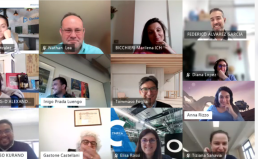
GenoMed4All holds 7th General Assembly as project nears completion
The GenoMed4All consortium held its 7th General Assembly on 8th April 2025, gathering all project partners for an online meeting to share progress updates and reflect on the project’s concluding months. As GenoMed4All moves toward its end in June, the assembly provided a valuable opportunity to align on key achievements, deliverables, and lasting impact across the project’s core work packages (WPs).
An ethical and compliant framework for clinical data
Nathan Lea (The European Institute for Innovation Through Health Data) opened the session with reflections on the evolving ethical and legal framework for AI in healthcare. Since 2022, GenoMed4All has adapted its approach to align with the incoming EU AI Act. Using the Assessment List for Trustworthy AI (ALTAI), the i~HD team produced a series of recommendations to guide the ethical development and deployment of AI in clinical contexts. These include principles on transparency, quality assurance and stakeholder engagement.
The final deliverable for WP2 consolidates these efforts by providing: an overview of the AI landscape in healthcare, a review of the AI technologies and algorithms developed in GenoMed4All, clinical use case insights, and forward-looking recommendations for high-risk AI systems in health. Nathan emphasized that this work will also support future EU initiatives, including sister project SYNTHEMA.
Catalina Gonzalez (Dedalus) and Elisabetta Sauta (Humanitas Research Hospital) shared the latest progress done as part of WP5, focused on anonymization tools and data harmonization. Their work ensures the privacy of clinical data in line with the ethical framework outlined by WP2, and enables a consistent pipeline for semi-automated data curation across various partner institutions.
Key contributions of this work package include: bioinformatics pipelines tailored to the project’s three use cases (MDS, SCD and MM); the development of a common data model for each use case based on HL7 FHIR standards; and ETL pipelines for extracting, harmonizing and integrating clinical, genomic and imaging data with the Federated Learning infrastructure.
Advancing AI and Federated Learning for personalized medicine
Silvia Uribe (Universidad Politecnica de Madrid), leader of WP4, explained how her team has been working on the design and implementation of the Federated Learning platform. This infrastructure will enable secure data sharing and AI model deployment across multiple institutions while maintaining data sovereignty, powered by high-performance computing (HPC) capabilities.
The team from University of Bologna (UNIBO), led by Gastone Castellani, has also made major contributions to the FL infrastructure, especially on AI model development for the the three clinical use cases. In close collaboration with Patricia Alonso (UPM), their work on WP6 has focused on: validation protocols to standardize AI testing, synthetic data generation for enhanced FL training and simulations, and the implementation of centralized AI algorithms for each use case. Luciana Carota (UNIBO) also highlighted the collaborative effort behind the development and testing of federated models, integrating data from partners across the consortium.
Gianluca Asti and Marilena Bicchieri (Humanitas Research Hospital) presented updates from WP7, emphasizing the deployment of AI for genomics-based predictions, particularly for the two oncological use cases: for MDS, it demonstrated an improved model performance in federated environments, even in an extreme scenario where some of the nodes in the federation has incomplete or missing data; for MM, they achieved successful simulation of early relapse scenarios using synthetic data. Overall, this work package underscores the power of federated learning to handle complex, high-dimensional genomic and imaging data.
Data standardization, open science and impact
Teresa García (Centre for Genomic Regulation) reported on progress in genomic data standardization, which is critical for continuous AI model training and the FAIRification of healthcare data; in this area, as she highlighted, one of the main challenges has been harmonizing heterogeneous datasets and terminologies across domains. To complement this work, Elisa Rossi (CINECA) remarked that parallel efforts have been taken to promote open data collaboration across the project.
As part of ongoing commitments to share the project’s efforts and achievements with the wider healthcare community and patient groups, a series of outreach and dissemination activities have been carried out throughout the last years, which have also supported capacity-building in data handling and open science practices. More recently, the team led by Mar Mañú (Vall d’Hebron Institute of Research) organised the second wave of training on AI in Hematology for an expert audience, co-hosted with and supported by ERN-EuroBloodNet.
Also to increase the project’s awareness among external audiences, Diana Lopez (AUSTRALO) explained how a series of communication strategies have been planned and implemented since the beginning of the project, including social media campaigns, website updates, and the ongoing management of the Zenodo repository. The AUSTRALO team has also developed an onboarding handbook to guide new clinical sites interested in joining the GenoMed4All platform.
To close the session, Anna Rizzo (Datawizard) spoke about the project’s exploitation plans and long-term vision, including integration with ERN-EuroBloodNet for continued use and development of the GenoMed4All platform.
Looking ahead
With the final months ahead, the GenoMed4All community is preparing for its presence at the European Hematology Association (EHA) Congress 2025 in Milan on 12–15 June, alongside colleagues from SYNTHEMA and ERN-EuroBloodNet.
Stay tuned for more updates as GenoMed4All enters its final chapter.


GenoMed4All partners gather in Barcelona for the project’s 6th General Assembly
On 17 and 18 January 2024, the GenoMed4All consortium met in-person to celebrate its 6th General Assembly in Barcelona. Our partner institution VHIR hosted the two-day meeting at their premises at Hospital Vall d’Hebron, where they warmly welcomed the attending partners who travelled there from all across Europe.
This GA represented a major milestone in the project’s journey — not only it gave partners the opportunity to meet face-to-face and enjoy some networking, but it also laid the foundations for what will be the last year working together as the GenoMed4All consortium. With the project set to finish at the end of 2024, the expectations and enthusiasm levels were at an all time high in Barcelona, as the next months will be crucial to bring together all the different strands of our EU-funded initiative.
GenoMed4All and SYNTHEMA: Paving the way for the next chapter in AI-powered healthcare for hematology
GenoMed4All’s Project Coordinator, Federico Alvarez from Universidad Politecnica de Madrid (UPM), opened the first day of the meeting with a joint session alongside partners from SYNTHEMA — a sister European initiative also exploring the use of artificial intelligence and clinical data to advance precision medicine in hematology.
After highlighting the synergies shared by both projects coordinated by UPM — which had been previously identified during [an online session in October 2023 — Principal Investigator Mar Mañú from VHIR and Scientific Director at ERN-EuroBloodNet took centre stage to introduce the progress made on the use case shared across both projects, focused on Sickle Cell Disease.
On the path to building a revolutionary, cross-European Federated Learning platform for clinical data
The GenoMed4All assembly continued with in-depth presentations by consortium partners leading the 9 work packages that conform the core tasks of the project.
From data privacy, AI user trust, algorithm development, stakeholder engagement and patients involvement, they covered all the key topics feeding into the project’s ultimate goal: to build a cross-European clinical data platform powered by Federated Learning to advance precision medicine in hematology.
Partners also laid out exciting plans for GenoMed4All’s journey as the project enters its last year. In the next few months we will unveil an exciting new series of webinars launched alongside ERN-EuroBloodNet, which marks the second instalment in our Educational Training Program focused on exploring the use of AI in Hematology. For those who missed the first wave, the sessions are available to watch on-demand on our YouTube channel.
On the technical side, the consortium will be dedicating their efforts to tackle 3 main priorities: finishing up the internal set up of remaining Federated Learning nodes, planning for the onboarding of clinical partners into the platform, and co-designing a sustainability plan as GenoMed4All evolves into its next phase through SYNTHEMA.
We look forward to continue working together to shape a new era of precision medicine for hematology through the power of AI and genomics.
Follow GenoMed4All on LinkedIn and X.
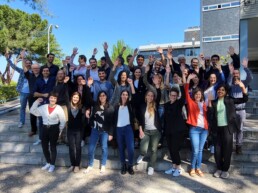
Our third General Assembly in Madrid
After nearly one year and a half of seeing each other online... we were finally able to meet in person for our third General Assembly!
Madrid was the chosen scenario and it did not disappoint in the slightest: sunny weather accompanied us throughout 2 days full of presentations, live discussions and brainstorming.
49 colleagues from our 23 partners got together to showcase the progress made on our use cases, AI modelling, data pre-processing and Federated Learning environment.
Here's to the next 6 months!

Kicking off 2022 with a second General Assembly
It's our first anniversary and there's no better way to celebrate than with a General Assembly! Though we could be together virtually, our ice-breaker pool made it clear: there's definitely a list of top destinations to choose from for a face-to-face meeting in the future.
After intense discussions on our use cases for Myelodysplastic Syndromes, Multiple Myeloma and Sickle Cell Disease, we discussed data sharing potentials, enjoyed a brainstorming session on our Federated Learning framework design principles... and started working through the details of our engagement strategy. The future is looking bright!


General Assembly #1 - the work so far
This week we celebrated our 6-month milestone with a General Assembly to reflect on the work done and all the challenges ahead.
As part of the meeting agenda, there were some breakout sessions planned to share the progress made on our use cases (both from the clinical and technical perspectives), discuss how to approach data sharing, ethics and GDPR and start working on our outreach and engagement strategy.